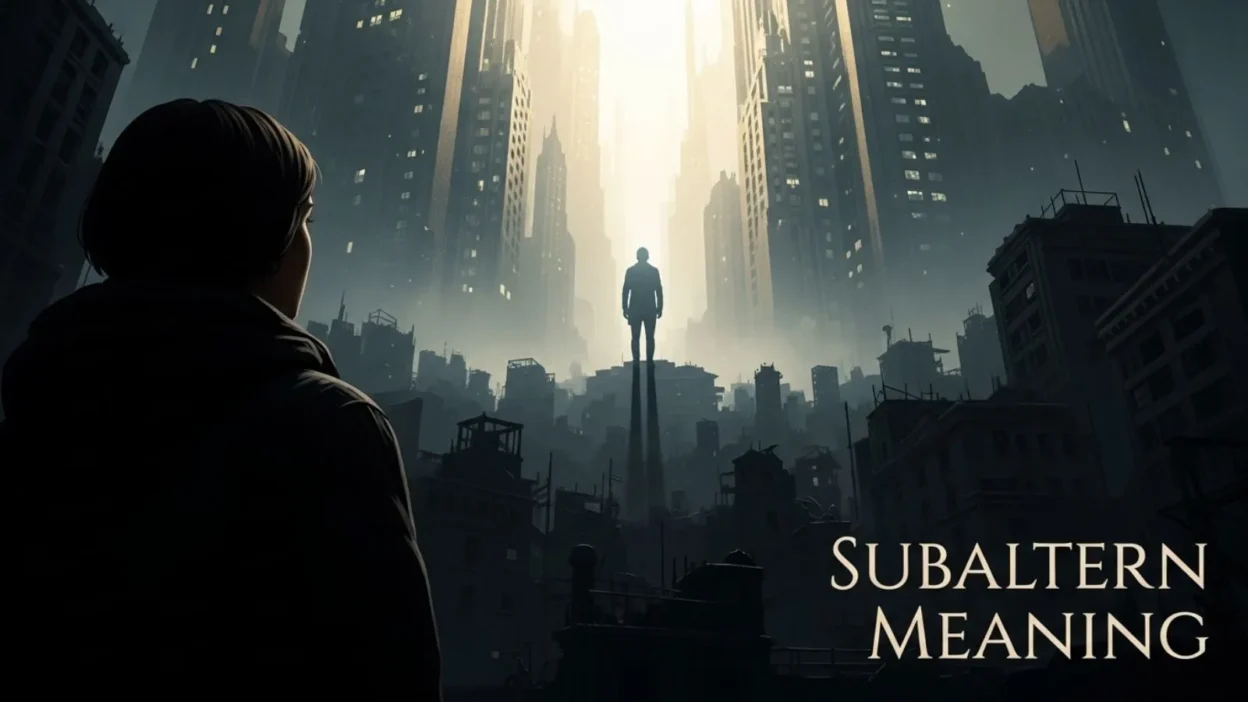
The term “subaltern meaning” refers to people or groups in society who are marginalised, oppressed, or excluded from positions of power. In simple words, subaltern describes those who have little voice or influence in political, social, or economic systems.
This concept is widely used in fields like sociology, history, and literature to explain inequality and social hierarchy.
Originally developed by Antonio Gramsci, the idea gained popularity in Postcolonial Studies to analyze the experiences of colonized and underrepresented communities.
Today, the word “subaltern” is commonly discussed on platforms like blogs, academic websites, and even social media such as WhatsApp, Instagram, and Facebook.
Understanding its meaning helps us better recognize issues like social injustice, discrimination, and lack of representation. In this article, you’ll learn the subaltern meaning in simple terms, along with examples, explanations, and real-world relevance.
🔰 What Does Subaltern Mean? (Simple Definition)
The subaltern meaning is quite simple when explained in everyday language. A subaltern refers to a person or group that exists outside the dominant power structure in society. These are people who often do not have access to resources, decision-making power, or a strong public voice. In short, subaltern groups are those who are socially, politically, or economically pushed to the margins.
The word became important through the work of Antonio Gramsci, who used it to describe groups that are excluded from mainstream power. Instead of just focusing on wealth, the concept highlights lack of representation and voice. For example, even if some groups are large in number, they may still be considered subaltern if they are not heard or respected in society.
In simple terms, you can think of subaltern as:
- People who are ignored or unheard
- Groups that face inequality or discrimination
- Communities with limited opportunities and rights
Some common synonyms include marginalized, oppressed, underprivileged, and disadvantaged. However, subaltern is a bit deeper because it focuses on powerlessness and invisibility, not just poverty.
For example, a rural worker with no political influence, a minority group facing discrimination, or a community without access to education can all be considered subaltern. Understanding this term helps us see how societies are structured and why some voices are louder than others.
📚 Origin of the Word “Subaltern”
The word subaltern has an interesting history that helps us better understand its modern meaning. It comes from the Latin roots “sub” (meaning under) and “alternus” (meaning other or subordinate). Together, these roots suggest someone who is placed under others in rank or authority.
Originally, the term was used in the military to describe a junior officer—someone who holds a lower rank and must follow orders from higher authorities. At this stage, the word had nothing to do with social inequality; it was simply about hierarchy within an organization.
However, the meaning of subaltern began to evolve in the 20th century, especially through the work of Antonio Gramsci. He used the term in a broader social and political sense to describe groups that are excluded from power and decision-making. For Gramsci, subaltern groups were not just lower in rank—they were systematically marginalized and silenced in society.
Later, the concept became central in Postcolonial Studies, where scholars used it to analyze the experiences of colonized and oppressed people. The word shifted from a simple military label to a powerful idea that explains social inequality, domination, and lack of representation.
Today, when we use the term “subaltern,” we are no longer talking about soldiers. Instead, we are referring to individuals and communities who are often ignored, unheard, and pushed to the margins of society.
🧠 Subaltern in Sociology and Politics
In sociology and politics, the subaltern meaning goes beyond a simple definition and becomes a way to understand how power and inequality shape society. It refers to groups of people who are excluded from decision-making processes and have little or no influence over political or social systems. These groups often remain unheard, even though their lives are deeply affected by the policies and rules created by those in power.
The concept was strongly influenced by Antonio Gramsci, who explained how dominant classes maintain control not just through force, but also through ideas, culture, and institutions. According to him, subaltern groups are those who are controlled by dominant powers and lack the ability to represent themselves effectively.
In sociology, subaltern is used to study social hierarchy, where society is divided into different levels based on power, status, and access to resources. Subaltern groups usually exist at the bottom of this hierarchy, facing challenges like poverty, discrimination, and limited opportunities.
In politics, the term highlights how certain communities are left out of governance.
For example:
- People who cannot vote or have limited political rights
- Communities that are ignored by policymakers
- Groups without proper representation in government
Understanding subaltern in this context helps us recognize why some voices dominate public discussions while others remain silent. It also encourages efforts toward equality, inclusion, and fair representation in modern society.
🏛️ Subaltern in History
When we look at history, the subaltern meaning becomes even clearer. It is often used to describe groups of people who were ruled, controlled, or ignored by powerful empires and elites. These groups did not have the ability to record their own stories, which is why much of history has traditionally been written from the perspective of the powerful rather than the powerless.
One of the most common historical examples of subaltern groups comes from the colonial period. During European rule in regions like South Asia, Africa, and Latin America, local populations were often treated as inferior. They had little political power, limited rights, and almost no voice in how they were governed. Their cultures, languages, and traditions were often suppressed or overlooked.
Historians later began to question this one-sided view of history. This led to the rise of the Subaltern Studies Group, which focused on telling history from the perspective of the marginalized. Instead of only studying kings and rulers, they explored the lives of peasants, workers, tribal communities, and ordinary people.
For example:
- Farmers who resisted unfair taxes during colonial rule
- Indigenous communities fighting to protect their land
- Laborers who struggled under harsh working conditions
These groups are considered subaltern because their voices were often ignored or silenced in official historical records. Studying subaltern history helps us see a more complete and honest picture of the past, giving recognition to those who were previously unheard.
📖 Subaltern in Literature and Postcolonial Theory
In literature and critical theory, the subaltern meaning is used to explore how certain voices are excluded, silenced, or misrepresented in written texts and historical narratives. Writers and scholars in this field focus on how stories are often told from the perspective of powerful groups, while the experiences of ordinary or marginalized people are ignored.
This idea became especially important in Postcolonial Studies, which examines the cultural and political impact of colonialism. Within this framework, the subaltern represents those who were colonized, oppressed, or socially pushed to the margins, and whose voices rarely appear in official records or mainstream literature.
A major contribution to this concept comes from scholars like Gayatri Chakravorty Spivak, who raised the famous question: “Can the subaltern speak?” Her argument suggests that even when marginalized groups try to express themselves, their voices are often filtered, misunderstood, or controlled by dominant systems of power.
In literature, subaltern characters are often:
- Poor or rural individuals with limited voice
- Colonized subjects under foreign rule
- Women or specific facing double marginalization
For example, many colonial-era novels focused on rulers and elites, while the struggles of common people were ignored. Modern postcolonial writers try to correct this by giving voice to those who were previously unheard.
Understanding subaltern in literature helps readers recognize how storytelling is shaped by power. It also encourages us to question whose voices are included and whose are missing, making literature a tool for awareness and social change.
👥 Who Are Considered Subaltern Groups?
In simple terms, subaltern groups are those sections of society that are marginalized, underrepresented, and excluded from power. These groups may exist in large numbers, but they often lack the ability to influence decisions in political, social, or economic systems. The subaltern meaning is therefore closely linked to inequality and lack of representation.
Subaltern groups are not defined only by poverty. Instead, they are identified by their limited access to voice, rights, and opportunities. In many cases, they are ignored in mainstream discussions and decision-making processes, which keeps them at the lower levels of social hierarchy.
Common examples of subaltern groups include:
- 🧑🌾 Rural and landless workers who depend on daily wages
- 👩 Women in patriarchal societies who face social restrictions
- 🏞️ Indigenous or tribal communities with limited state support
- 🧑🎓 Economically weaker sections with poor access to education
- 🧑🤝🧑 Religious or ethnic specific facing discrimination
- 🧳 Migrants and refugees who struggle for basic rights
These groups often share a common issue: their voices are not fully represented in power structures, whether in government, media, or education systems.
The concept of subaltern was influenced by thinkers like Antonio Gramsci, who explained how dominance works not only through force but also through control of ideas and institutions. This helps us understand why some groups remain unheard even in modern societies.
Recognizing subaltern groups is important because it highlights the need for social justice, equality, and inclusion. It reminds us that a fair society must ensure that every group has a voice, not just the powerful ones.
💡 Real-Life Examples of Subaltern
To clearly understand the subaltern meaning, it is helpful to look at real-life examples. Subaltern groups are found in every society, and they include people who are socially, economically, or politically pushed to the margins. These individuals or communities often struggle to have their voices heard in decision-making processes.
One common example is rural laborers and daily wage workers. They work hard in fields, construction sites, or factories, but often have little say in policies that affect their lives. Their lack of political influence makes them part of subaltern groups.
Another example includes indigenous communities who live in remote areas. These groups may have rich cultures and traditions, but they often face challenges like limited access to education, healthcare, and government support. Because their voices are rarely included in mainstream systems, they are considered subaltern.
Women in patriarchal societies can also be seen as subaltern in certain contexts. Even though they form half of the population, they may face restrictions in education, employment, or leadership roles, which limits their representation in decision-making.
In addition, refugees and migrants often experience subaltern conditions. They may lose their homes, rights, and identity while trying to survive in new environments where they have little legal or social power.
Historically, during colonial rule, entire populations in colonized regions were treated as subaltern under foreign powers, which is why thinkers like Antonio Gramsci helped develop this concept to explain such inequalities.
These examples show that subaltern is not just a theory—it reflects real human experiences of inequality, silence, and struggle for recognition in society.
⚖️ Subaltern vs Elite: Key Differences
To fully understand the subaltern meaning, it is important to compare it with the elite class in society. These two groups represent opposite positions in the social hierarchy and help explain how power is distributed.
The elite refers to people or groups who hold power, wealth, education, and influence. They usually take part in decision-making processes and have strong access to political, economic, and social systems. In contrast, subaltern groups are those who are excluded from these systems and have very limited or no influence over important decisions.
One major difference is access to power. Elites shape laws, policies, and institutions, while subaltern groups are often affected by these decisions without being included in them. This creates a clear imbalance in society.
Another difference is representation. Elite voices are frequently heard in media, politics, and education. Subaltern voices, on the other hand, are often ignored or underrepresented, even when they represent large populations.
The concept was deeply analyzed by thinkers like Antonio Gramsci, who explained how dominant groups maintain control not only through authority but also through cultural influence and ideas. This helps us understand why inequality continues even in modern societies.
Examples of elite vs subaltern:
- Elite: Government leaders, wealthy business owners, top professionals
- Subaltern: Rural workers, marginalized communities, refugees
The key difference is not just income, but control and visibility in society. While elites shape the system, subaltern groups often struggle within it.
Understanding this contrast helps us recognize social inequality and the importance of creating a more balanced and inclusive society where every group has a voice.
🌐 Why the Concept of Subaltern Matters Today
The idea of subaltern meaning is not just a historical or academic concept—it is highly relevant in today’s world. It helps us understand how inequality, exclusion, and lack of representation still exist in modern societies. Even in the 21st century, many groups continue to live without equal access to power, education, and opportunities.
One of the main reasons this concept matters is that it highlights social injustice. Subaltern groups often face challenges such as poverty, discrimination, and limited political participation. By studying this concept, we become more aware of how society is structured and why some voices are stronger than others.
It also plays an important role in promoting social equality and human rights. When we recognize subaltern communities, we can work toward policies that include them in decision-making processes. This helps reduce inequality and creates a more balanced society.
The concept, influenced by thinkers like Antonio Gramsci, reminds us that power is not only about government or money, but also about whose voices are heard and respected in society.
In today’s world, subaltern issues can be seen in:
- Lack of education access in rural areas
- Gender inequality in workplaces
- Discrimination against specific
- Economic gaps between rich and poor
Understanding subaltern also encourages awareness and activism. Many social movements today focus on giving voice to marginalized communities and ensuring fair treatment for all.
In short, the concept of subaltern remains important because it pushes us to ask a simple but powerful question: Who is being heard, and who is being ignored in society today?
🌐 Subaltern in Modern Society
In today’s world, the subaltern meaning is still very relevant because social and economic inequality continues to exist in many forms. Even though societies have progressed in education, technology, and governance, not everyone has equal access to opportunities or representation. Subaltern groups in modern society are those who remain marginalized or excluded from mainstream systems of power.
One major example is the digital divide. In the modern age, access to the internet and digital tools is essential for education, jobs, and communication. However, many rural and low-income communities still lack reliable internet access, which limits their opportunities and keeps them socially and economically behind.
Another example is economic inequality. Wealth is often concentrated in the hands of a small elite group, while low-income workers struggle to meet basic needs. These individuals may have little influence over government policies or workplace decisions, placing them in a subaltern position.
Social issues such as gender inequality, discrimination against specific , and refugee crises also highlight subaltern conditions in today’s world. These groups often face barriers that prevent them from fully participating in society.
The idea, influenced by thinkers like Antonio Gramsci, helps us understand that power is not only about authority but also about who is heard and who is ignored in society.
Even social media, while giving voice to many, does not completely eliminate subaltern conditions. Some voices still remain unheard due to lack of access, visibility, or influence.
Understanding subaltern in modern society encourages us to work toward a more inclusive, equal, and fair world where every group has the opportunity to be represented and respected.
🔄 Synonyms and Related Terms of Subaltern
To fully understand the subaltern meaning, it is useful to explore its synonyms and related terms. These words help explain the concept from different angles, especially in sociology, politics, and everyday language. However, it is important to remember that while these terms are similar, they are not always exactly the same in meaning.
Some common synonyms of subaltern include marginalized, oppressed, underprivileged, and disadvantaged. These words describe people or groups who face social or economic inequality and have limited access to resources or opportunities.
Other related terms include weaker sections of society, excluded groups, and lower social classes. These phrases are often used in discussions about poverty, inequality, and social justice.
In academic discussions, especially in Postcolonial Studies, the term subaltern is used in a more specific way. It not only refers to poverty or disadvantage but also focuses on lack of voice, representation, and power in society.
It is also important to understand the subtle differences:
- Marginalized → Focuses on being pushed to the edge of society
- Oppressed → Focuses on active control or suppression
- Underprivileged → Focuses on lack of resources
- Subaltern → Focuses on silenced voice and powerlessness in systems
The concept, popularized by thinkers like Antonio Gramsci, highlights that subaltern groups are not just poor, but often excluded from decision-making and visibility.
Using these synonyms correctly helps us better understand social inequality and communicate ideas about justice, inclusion, and representation more clearly in both academic and everyday contexts.
❌ Common Misunderstandings About Subaltern
The subaltern meaning is often misunderstood, especially by people who are new to sociology or political theory. Because the word is used in different contexts, many people confuse it with similar terms like “poor” or “lower class,” but its meaning is actually much deeper and more complex.
One common misunderstanding is that subaltern only refers to poor people. While poverty can be a part of it, subaltern is not defined by income alone. A group can be financially stable but still be considered subaltern if it lacks political voice, representation, or social power.
Another mistake is thinking that subaltern is only related to developing countries. In reality, subaltern groups exist in every society, including developed nations. For example, specific , immigrants, and marginalized communities in any country can fall under this category.
Some people also assume that subaltern groups are completely powerless. However, this is not always true. These groups may still resist, organize, and express themselves, even if their voices are not widely recognized in mainstream systems.
The concept, developed by thinkers like Antonio Gramsci, emphasizes that subalternity is about systemic exclusion, not just personal weakness or poverty. It focuses on how power structures silence certain groups in society.
Another misunderstanding is that subaltern is a permanent identity. In reality, social conditions can change over time. With education, awareness, and policy changes, groups can move out of subaltern conditions.
Understanding these misconceptions helps us use the term more accurately and appreciate its deeper meaning in discussions about inequality, representation, and social justice.
❓ FAQs About Subaltern Meaning
H3: What is the simple meaning of subaltern?
Subaltern means people or groups in society who are marginalized, excluded, or have very little power and voice in decision-making. They are often ignored in political, social, or economic systems.
H3: Who introduced the concept of subaltern?
The concept was developed by Antonio Gramsci, who used it to describe groups that are excluded from dominant power structures in society.
H3: What is subaltern in sociology?
In sociology, subaltern refers to groups that are placed at the lower level of social hierarchy, often lacking access to power, resources, and representation.
H3: What is subaltern in literature?
In literature, subaltern refers to silenced or unheard voices, especially those of colonized or marginalized people whose stories are often ignored in mainstream writing.
H3: Can subaltern speak? What does it mean?
This question comes from postcolonial theory. It suggests that even when marginalized groups try to express themselves, their voices are often misinterpreted or controlled by dominant systems.
🧾 Conclusion
In conclusion, the subaltern meaning refers to groups or individuals in society who are marginalized, excluded, and lacking power or representation.
It is not just about poverty but about silence, inequality, and lack of voice within social, political, and economic systems.
From its early use in military language to its modern role in sociology and Postcolonial Studies, the concept has evolved into an important tool for understanding social structures.
Thinkers like Antonio Gramsci helped shape this idea, showing how power works not only through authority but also through control of culture and knowledge.
Today, the concept helps us recognize real-world issues like inequality, discrimination, and underrepresentation.

Oliver Wordsmith is the creative mind behind Punnery.com, a website full of clever puns, witty wordplay, and visual jokes. At Punnery.com, Oliver shares content that makes readers laugh, sparks creativity, and celebrates the playful side of language.