The term “cannon meaning” is commonly searched by students, writers, and curious readers who want a clear and simple explanation of this powerful word.
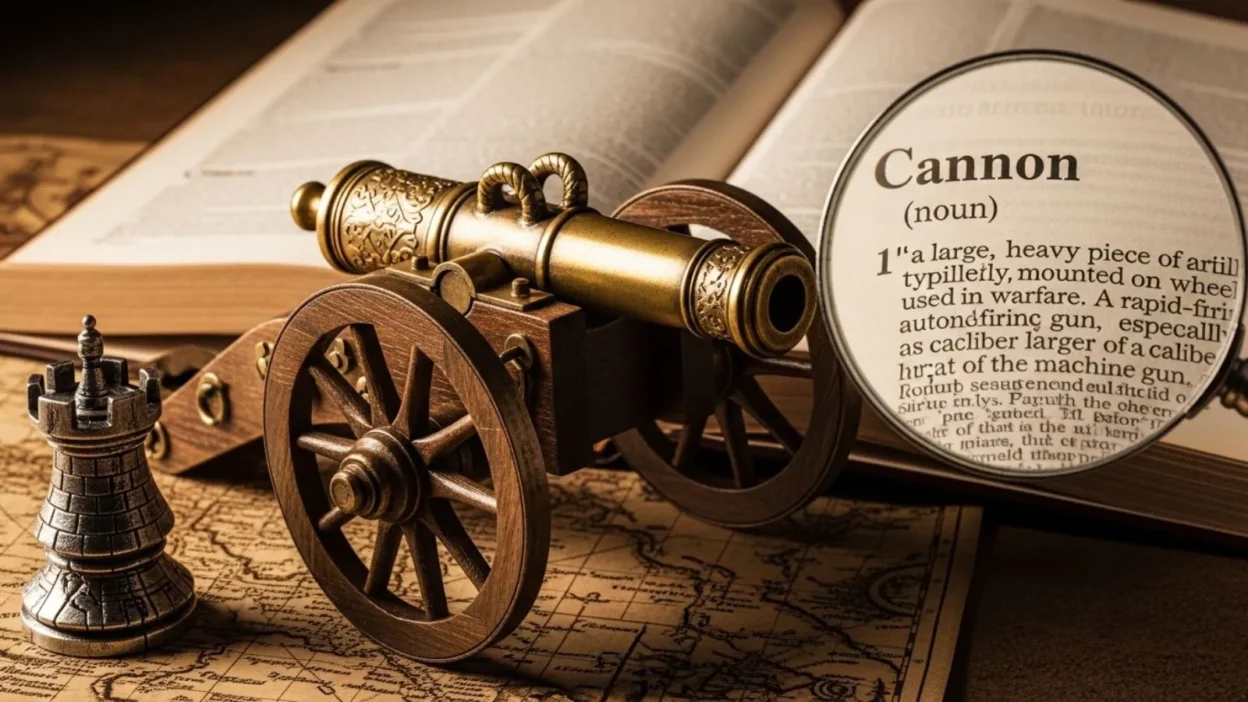
A cannon is a large, heavy gun designed to fire projectiles over long distances, mainly used in historical and modern warfare.
From ancient battlefields to naval ships, cannons have played a major role in shaping military history.
However, many people also confuse “cannon” with “canon,” which has a completely different meaning related to rules, standards, or literature.
Understanding the correct meaning, pronunciation, and usage of “cannon” is important for both academic and everyday English.
In this article, you will learn the exact definition of cannon, its origin, types, real-life examples, and key differences from similar words, making your understanding clear and complete.
What Does Cannon Mean?
The cannon meaning is simple but powerful. A cannon is a large, heavy weapon designed to launch projectiles, such as metal balls or explosive shells, over long distances. It is one of the earliest forms of artillery and has been widely used in wars, especially from the medieval period onward. Cannons are typically mounted on wheels or fixed platforms, allowing them to be positioned strategically on battlefields, forts, or ships.
In basic terms, if someone asks “what is a cannon?”, the easiest answer is: a very large gun used in warfare. Unlike small firearms, cannons are much bigger, louder, and more destructive. They rely on explosive force—traditionally gunpowder—to fire ammunition with great speed and impact.
The word is pronounced as /ˈkæn.ən/ (KAN-uhn), and it is commonly used in both historical and educational contexts. You may see the term in history books, movies, or documentaries that focus on battles and military technology.
It’s also important to note that the meaning of cannon is usually literal, referring to the weapon itself. However, in some creative or informal contexts, it can be used metaphorically to describe something powerful or forceful.
Types of Cannons (Historical & Modern)
Understanding the cannon meaning becomes even clearer when you explore the different types of cannons used throughout history. Over time, cannons have evolved from simple metal tubes to highly advanced military weapons.
In early history, ancient cannons were basic and often made of cast iron or bronze. They were first used in China and later spread to the Middle East and Europe. These early versions were not very accurate but were powerful enough to break walls and scare enemies.
During the medieval period, medieval cannons became more refined. Armies used them in sieges to destroy castles and fortifications. These cannons were larger, stronger, and more reliable than earlier designs, making them a key part of warfare.
Another important type is the naval cannon, which was mounted on warships. These cannons played a huge role in sea battles, allowing ships to attack enemies from a distance. They were essential during major naval wars and explorations.
In modern times, cannons have developed into advanced artillery systems such as field guns and howitzers. These modern artillery cannons are highly accurate, long-range, and use advanced technology for targeting and firing.
Each type reflects the evolution of warfare, showing how the simple idea behind the cannon definition has grown into complex and powerful military equipment.
Origin and Etymology of Cannon
6
The cannon meaning becomes even more interesting when we look at its origin and history. The word cannon comes from the Latin term “canna,” which means tube or reed. This makes sense because early cannons were shaped like long metal tubes used to launch projectiles. Over time, the word passed into Old French as “canon,” and later entered the English language with the spelling “cannon.”
As the technology of weapons developed, the meaning of the word also became more specific. In the beginning, it could refer to any tube-like object, but eventually, it became strongly associated with large firearms used in warfare. By the 14th and 15th centuries, cannons were widely used across Europe, and the word had fully taken on its modern definition.
Interestingly, the similarity between cannon and canon comes from this shared origin, but their meanings later separated. While cannon refers to a weapon, canon evolved to mean a rule, law, or accepted standard—especially in religion, literature, and art.
Learning the etymology of cannon not only helps you understand the word better but also makes it easier to remember its correct usage. It shows how language evolves alongside human invention and history.
How to Use “Cannon” in Sentences
Using the word “cannon” correctly in sentences helps you fully understand its meaning and improves your English writing skills. Since the term mainly refers to a large weapon, it is often used in historical, military, or descriptive contexts.
In simple sentences, cannon is used as a noun. For example:
- The soldiers fired the cannon during the battle.
- An old cannon was displayed in the museum.
- The ship was equipped with powerful cannons.
These examples clearly show the cannon meaning as a weapon used for attack or defense. You can also use the word in educational or storytelling contexts, especially when describing past events.
For more advanced usage, cannon can appear in detailed or descriptive sentences:
- The massive iron cannon stood at the edge of the fort, reminding visitors of ancient wars.
- With a loud roar, the cannon launched a heavy projectile across the battlefield.
In some creative writing, cannon may be used metaphorically to describe something strong or forceful:
- His words hit like a cannon, leaving everyone silent.
It’s important to remember that cannon is a countable noun, so it can be singular (a cannon) or plural (cannons). By practicing these examples, you can confidently use the word in both basic and advanced English communication.
Cannon vs Canon (Very Important Difference)
One of the most important parts of understanding the cannon meaning is learning the difference between “cannon” and “canon”, because these two words are often confused due to their similar spelling and pronunciation.
A cannon is a large weapon used in warfare. It is designed to fire heavy projectiles over long distances and is commonly seen in historical battles, forts, and ships. In simple terms, cannon refers to a physical military weapon used for destruction or defense.
On the other hand, canon has a completely different meaning. It refers to a set of rules, standards, or accepted principles in a particular field. For example, in literature, the “canon” of an author includes all officially recognized works. In religion, it can refer to official laws or sacred texts.
Here is a simple comparison:
- Cannon → A powerful weapon used in war
- Canon → A set of rules, laws, or accepted works
Example sentences:
- The cannon fired during the battle.
- Shakespeare’s works are part of the literary canon.
This difference is very important for writers, students, and English learners because mixing these words can completely change the meaning of a sentence. Understanding this distinction ensures that your usage of the cannon definition is always correct and clear.
Figurative and Modern Usage of Cannon
Although the cannon meaning originally refers to a large military weapon, the word is also used in figurative and modern contexts. Over time, language has evolved, and “cannon” is sometimes used to describe anything powerful, fast, or forceful in a non-literal way.
In everyday English, people may use “cannon” metaphorically to emphasize strength or impact. For example, in sports, a player with a very powerful kick or shot might be described as having a “cannon leg” or “cannon shot.” This highlights extreme power rather than referring to an actual weapon.
In entertainment and pop culture, cannons are often shown in movies, cartoons, and video games. Here, they are not only historical weapons but also dramatic tools used for action scenes, humor, or fantasy battles. For example, a cartoon might show a character being launched from a cannon for comedic effect.
The word is also used symbolically to represent force, energy, or sudden impact. In this sense, it goes beyond the basic cannon definition and becomes a creative expression in language.
However, it is important to remember that these figurative uses are informal. In academic writing or historical discussions, “cannon” should always refer to the actual weapon.
Understanding both literal and figurative meanings helps you use the word correctly in different situations, making your grasp of the cannon meaning more complete and versatile.
Synonyms, Related Words, and Common Confusions
To fully understand the cannon meaning, it also helps to look at related words, synonyms, and common terms that are often used in similar contexts. Since a cannon is a type of weapon, many of its related words come from military language.
Some simple synonyms or closely related words include:
- artillery
- gun
- weapon
- field gun
- howitzer
However, these are not exact replacements. For example, artillery is a broader term that includes cannons and other large weapons, while a howitzer is a specific type of cannon designed to fire shells in a high arc.
Understanding related terms helps you see where cannons fit in the larger category of military equipment. In history and defense studies, cannons are often grouped under artillery systems, which include all large-caliber guns used in warfare.
Another important part of learning the cannon definition is avoiding confusion with similar-looking or similar-sounding words. The most common mistake is mixing “cannon” with “canon.” As discussed earlier, cannon refers to a weapon, while canon refers to rules or accepted standards.
By learning synonyms and related terms, you gain a deeper understanding of how cannons are classified and used in both historical and modern contexts. This makes your knowledge of the word more complete and accurate.
Common Mistakes People Make (and Why They Happen)
When learning the cannon meaning, many people make simple but important mistakes, especially because the word looks and sounds similar to other English words. Understanding these mistakes helps you use the word correctly in writing and speaking.
One of the most common errors is spelling confusion between “cannon” and “canon.” Many learners accidentally swap the letters, which changes the meaning completely. A cannon is a large weapon used in warfare, while canon refers to rules, standards, or accepted works in literature and religion. Mixing them can lead to incorrect sentences and misunderstanding.
Another mistake is using “cannon” in the wrong context. Some people use it in general situations where it does not fit. Since cannon specifically refers to a type of military weapon, it should not be used to describe ordinary objects or actions unless used metaphorically.
Pronunciation errors are also common. Some learners mispronounce it, but the correct pronunciation is KAN-uhn. Saying it correctly is important for clear communication.
Lastly, some writers forget the plural form. The correct plural is “cannons”, not “cannon’s” (which shows possession, not plural).
Avoiding these mistakes helps you better understand the cannon definition and improves your overall English accuracy. Paying attention to spelling, context, and grammar ensures that your usage is always correct and professional.
Why Understanding Cannon Meaning is Important
Understanding the cannon meaning is more important than it may first appear, especially for students, writers, and anyone learning English. A clear understanding of this word helps avoid confusion in reading, writing, and communication.
First, it is important for students and academic learning, especially in subjects like history. Cannons played a major role in wars and battles, so knowing what a cannon is helps students better understand historical events, military strategies, and how warfare evolved over time.
Second, it is useful for English language learners. Since “cannon” is often confused with “canon,” understanding the difference improves vocabulary accuracy and prevents common spelling or meaning mistakes. This is especially important in exams, essays, and formal writing.
Third, it helps writers and content creators use the word correctly in storytelling, articles, or descriptions. Using the correct meaning adds clarity and professionalism to writing.
Finally, learning the cannon definition also improves general knowledge. Even if someone is not studying history or language deeply, understanding commonly used words strengthens communication skills and confidence.
In short, knowing the meaning of cannon is not just about vocabulary—it connects language with history, education, and real-world understanding.
Frequently Asked Questions (FAQs)
🔹 What is the meaning of cannon in simple words?
A cannon is a large, powerful gun used in wars to fire heavy projectiles over long distances. In simple terms, it is a big weapon used in historical and modern warfare.
🔹 Is cannon a weapon?
Yes, a cannon is a type of artillery weapon. It was widely used in battles, especially in the past, to attack enemies or break strong defenses like castle walls.
🔹 What is the difference between cannon and canon?
Cannon refers to a weapon used in warfare, while canon refers to rules, standards, or accepted works in literature, religion, or other fields. They sound similar but have completely different meanings.
🔹 How do you pronounce cannon?
The correct pronunciation of cannon is KAN-uhn. The stress is on the first syllable, and the ending is soft.
🔹 Where are cannons used today?
Modern cannons are used mainly in military artillery systems. They are also seen in museums, historical sites, and war memorials as part of history and education.
Conclusion
Understanding the cannon meaning gives you a clear picture of one of history’s most powerful weapons and its role in shaping warfare.
A cannon is a large artillery gun designed to fire heavy projectiles over long distances, widely used in ancient, medieval, and modern military systems.
Along with its historical importance, it is also important to remember the difference between “cannon” and “canon,” as both words are often confused but have completely different meanings.
Learning the origin, types, usage, and examples of cannon not only improves your vocabulary but also strengthens your general knowledge, especially in history and English language learning.
From battlefields to museums, the cannon remains a symbol of strength, power, and technological evolution.

Oliver Wordsmith is the creative mind behind Punnery.com, a website full of clever puns, witty wordplay, and visual jokes. At Punnery.com, Oliver shares content that makes readers laugh, sparks creativity, and celebrates the playful side of language.