Have you ever heard the word savannah in a nature documentary, geography class, or even as a baby name and wondered what it really means?
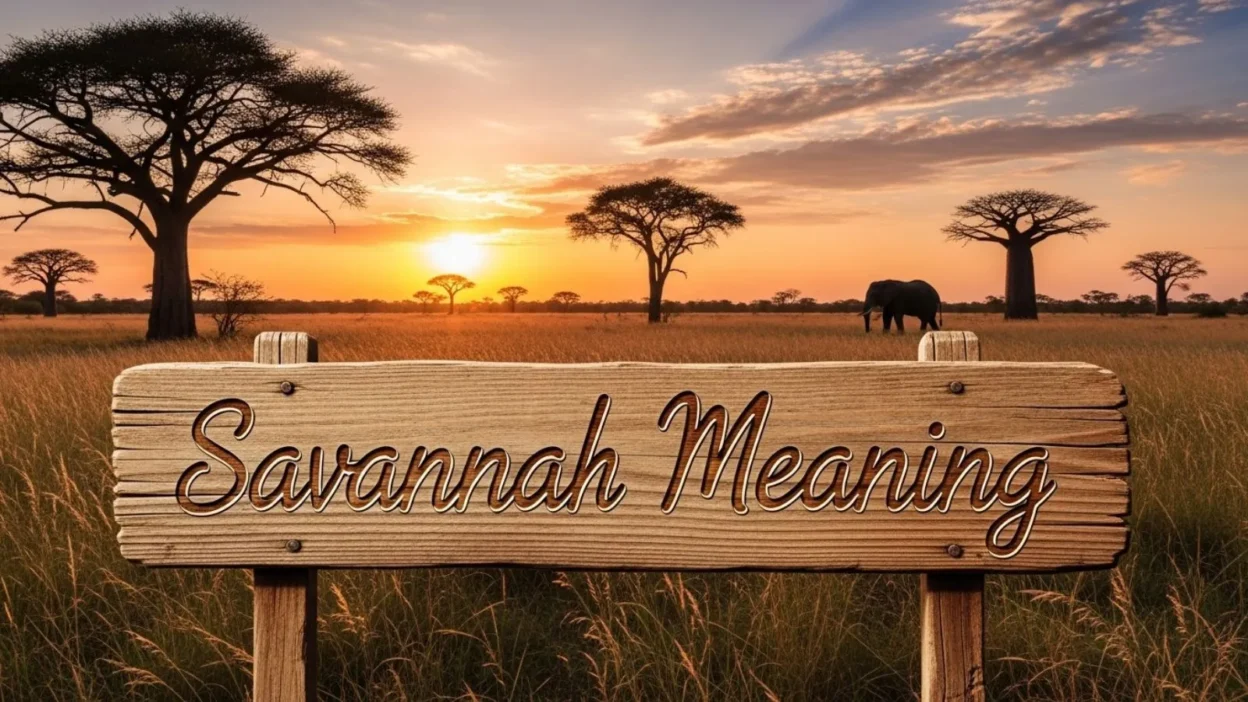
The savannah meaning can be a little confusing at first because the word is used in more than one context. In geography and ecology, a savannah refers to a vast tropical grassland ecosystem known for its open landscapes, scattered trees, and diverse wildlife.
These regions are home to some of the world’s most famous animals, including lions, elephants, and giraffes, making the savannah one of the most fascinating environments on Earth.
At the same time, Savannah is also a popular given name, often associated with natural beauty, openness, and strength.
Because of its connection to nature and wide landscapes, the name carries a peaceful and adventurous feeling.
In this article, we will explore the savannah meaning, its origin, pronunciation, ecological significance, and why the word has become so widely recognized today.
What Does Savannah Mean?
The savannah meaning refers to a type of natural landscape known as a tropical or subtropical grassland ecosystem. In simple terms, a savannah is a wide, open area covered mostly with grasses and a few scattered trees. Unlike dense forests where trees grow close together, savannahs have plenty of open space that allows sunlight to reach the ground, helping grasses grow easily. These ecosystems are usually found in regions that experience warm temperatures throughout the year along with distinct wet and dry seasons.
From a scientific and geographical perspective, the savannah definition describes a biome that lies between tropical rainforests and deserts. It receives enough rainfall to support grasses and some trees, but not enough to create thick forests. Because of this unique balance of climate and vegetation, savannahs support a wide variety of plants and animals that have adapted to survive in changing seasonal conditions.
When people ask what is a savannah, they are often referring to the famous African landscapes seen in wildlife documentaries. However, savannah ecosystems are not limited to Africa. They also exist in parts of South America, Australia, and Asia. Each region has its own unique mix of plants, animals, and environmental conditions.
In addition to its geographical meaning, the word Savannah is also commonly used as a personal name. As a name, it is often associated with nature, freedom, and natural beauty, which reflects the open and peaceful landscapes that the word originally described.
Origin and Etymology of Savannah
To fully understand the savannah meaning, it is helpful to explore where the word originally came from. The term savannah has a long linguistic history that dates back several centuries. It is believed to have originated from the Spanish word “sabana,” which early explorers used to describe large, open plains covered with grass. Spanish explorers encountered these landscapes while traveling through the Caribbean and parts of the Americas.
The Spanish word sabana itself was influenced by the language of the Indigenous Taíno people who lived in the Caribbean region. In their language, the term referred to open fields or treeless plains. When European explorers documented the landscapes they saw in the New World, they adopted this word and gradually adapted its spelling and pronunciation into English as savanna or savannah.
Over time, the word became widely used in geography and environmental science to describe a specific type of ecosystem. Scientists and researchers began using the term to classify tropical grasslands that have scattered trees and seasonal rainfall. Because these landscapes are found in several parts of the world, the word savannah became an important term in ecological studies.
Interestingly, the spelling of the word has evolved over time. Both “savanna” and “savannah” are accepted spellings today. The shorter form is more commonly used in scientific writing, while the spelling with the extra “h” is often used in general writing and place names, such as the historic city of Savannah in the United States.
Savannah in Geography
In geography, the savannah meaning refers to a specific type of biome, or large ecological region, characterized by vast grasslands with scattered trees and shrubs. Savannahs are typically located in tropical and subtropical regions of the world where temperatures remain warm throughout the year. These areas experience a clear pattern of wet and dry seasons, which plays an important role in shaping the landscape and the types of plants and animals that live there.
When people ask what is a savannah in geography, they are referring to these wide, open grassland ecosystems that exist between dense tropical rainforests and dry deserts. Savannahs receive moderate rainfall, usually enough to support grasses and a limited number of trees but not enough to allow thick forests to develop. This balance creates a unique environment where both grassland and woodland features can be seen.
One of the most famous examples is the African savannah, which stretches across several countries and supports an incredible variety of wildlife. Animals such as lions, elephants, giraffes, and zebras thrive in these open habitats because the landscape provides both food and space for migration. The African savannah is often highlighted in wildlife films and educational programs about nature.
However, savannah ecosystems are not limited to Africa. Large savannah regions can also be found in South America, particularly in Brazil’s Cerrado region, as well as in northern Australia and parts of India. Each of these regions has its own climate patterns, plant species, and animal populations, making every savannah ecosystem unique while still sharing the same basic geographical characteristics.
Characteristics of a Savannah Ecosystem
Understanding the savannah meaning becomes easier when we look at the key features that define this unique ecosystem. A savannah is known for its open grasslands, scattered trees, and a climate that includes both wet and dry seasons. These characteristics create an environment that supports a wide variety of plants and animals while maintaining a balance between grassland and woodland habitats.
One of the most important characteristics of a savannah ecosystem is its climate. Savannahs are typically warm throughout the year, with temperatures that rarely drop very low. They experience a seasonal pattern where several months bring rainfall, followed by a long dry period. This seasonal rainfall helps grasses grow quickly during the wet season, while the dry season limits the growth of dense forests.
Another key feature is vegetation. Grass is the dominant plant type in most savannah regions. These grasses are well adapted to survive drought, grazing animals, and even natural fires. Trees and shrubs also grow in savannahs, but they are usually spaced far apart. Many of these trees have deep roots or thick bark that help them survive dry conditions.
Wildlife diversity is another defining characteristic of the savannah ecosystem. These regions support many herbivores such as zebras, antelopes, and elephants, which feed on grasses and plants. In turn, carnivores like lions and cheetahs depend on these herbivores for survival.
Plants Found in the Savannah
Plant life is an essential part of understanding the savannah meaning, because vegetation shapes the entire ecosystem. The plants that grow in savannah regions are specially adapted to survive hot temperatures, seasonal rainfall, grazing animals, and occasional wildfires. Because of these conditions, the vegetation in a savannah is quite different from that of forests or deserts.
The most common plants found in a savannah are grasses. In fact, grasses dominate most of the landscape and form the foundation of the food chain. These grasses grow quickly during the rainy season and provide food for many herbivores such as zebras, antelopes, and elephants. Many savannah grasses have deep root systems that allow them to survive long dry periods and grow back quickly after fires.
In addition to grasses, scattered trees and shrubs are another important part of the savannah ecosystem. Unlike forests where trees grow close together, savannah trees are spaced widely apart. This allows sunlight to reach the ground and supports the growth of grasses. Some of the most well-known trees found in savannah regions include the umbrella-shaped Acacia tree and the massive Baobab tree. These trees are well adapted to dry conditions and often have thick bark or deep roots that help them store water.
Shrubs and small plants also grow throughout the savannah, adding to the biodiversity of the region. Together, grasses, trees, and shrubs create a balanced ecosystem that supports many different animal species. Without these specially adapted plants, the savannah environment would not be able to sustain its rich and diverse wildlife.
Animals That Live in the Savannah
The savannah meaning is incomplete without understanding the incredible variety of animals that inhabit this unique ecosystem. Savannahs are home to some of the most iconic wildlife on Earth, and the open grasslands provide both food and space for these animals to thrive. The ecosystem’s combination of grasses, scattered trees, and seasonal rainfall supports a rich food chain, from herbivores to apex predators.
At the base of the food chain are herbivores. Animals like zebras, giraffes, elephants, antelopes, and wildebeest feed on grasses, leaves, and shrubs. Their grazing helps maintain the balance of the savannah by preventing overgrowth of vegetation. Many of these herbivores migrate seasonally in search of fresh water and grass, which is a defining feature of savannah life.
Predators are another essential part of the savannah ecosystem. Lions, cheetahs, leopards, and hyenas hunt herbivores for food. These carnivores play a crucial role in controlling herbivore populations and maintaining ecological balance. The open landscape of the savannah allows predators to use speed, strategy, and teamwork to catch their prey.
Birds and insects also thrive in savannahs. Birds like ostriches, secretary birds, and various raptors are common, while insects such as termites play a critical role in decomposing organic matter and enriching the soil. Other smaller animals, including reptiles and amphibians, are adapted to survive the alternating wet and dry seasons.
Savannah vs Savanna: Spelling Difference
When exploring the savannah meaning, many people notice that the word appears in two forms: “savannah” and “savanna.” While they may look different, both spellings refer to the same type of ecosystem—a tropical or subtropical grassland with scattered trees. Understanding the spelling difference can help clarify the use of the term in writing, geography, and everyday conversation.
The word “savanna” (without the “h”) is more commonly used in scientific and ecological contexts. Researchers, geographers, and biologists often prefer this spelling in textbooks, research papers, and academic articles. It is considered the standard form in environmental science because it closely follows the original Spanish word “sabana.”
On the other hand, “savannah” (with the “h”) is frequently used in general writing, literature, and names. For example, the historic city of Savannah in the United States uses the “h” spelling. Additionally, when Savannah is used as a personal name, the “h” is almost always included. This spelling is often associated with elegance, familiarity, and a softer appearance in English writing.
It’s important to note that despite the difference in spelling, the meaning of both words remains the same. They both describe a biome with open grasslands, seasonal rainfall, and scattered trees, supporting diverse plant and animal life. Writers can choose the spelling based on context—academic or casual—without changing the intended meaning.
Savannah as a Name
Beyond its ecological meaning, Savannah is also a popular given name, particularly for girls. The name draws inspiration from the natural landscape, symbolizing openness, beauty, and freedom, much like the wide, sunlit grasslands of the savannah ecosystem. Because of this connection to nature, it evokes a sense of calmness, strength, and adventure, which appeals to parents looking for meaningful and unique names for their children.
The origin of the name Savannah is closely linked to the geographical term. As discussed earlier, the word comes from the Spanish “sabana”, meaning open plains. Over time, it was adopted as a personal name in English-speaking countries, particularly in the United States, where it has steadily grown in popularity since the late 20th century.
Many people choose the name Savannah not only for its natural association but also for its soft, flowing sound, making it easy to pronounce and remember. It often conveys qualities such as kindness, independence, and a free spirit. In literature and media, characters named Savannah are frequently portrayed as adventurous, thoughtful, and connected to nature, reinforcing the name’s symbolic meaning.
Savannah also has global appeal, being used in other countries while retaining its natural and peaceful connotations. Whether chosen for its connection to nature, its elegance as a name, or its simple, melodic sound, Savannah continues to be a meaningful and attractive choice for parents. In this way, the name beautifully reflects the qualities of the ecosystem it is named after.
How to Pronounce Savannah
Understanding the savannah meaning also involves knowing how to pronounce the word correctly. Pronunciation is important, especially because the term is used both in geography and as a personal name, and a small mistake can change its impression entirely. The correct pronunciation of savannah is suh-VAN-uh, with the emphasis placed on the second syllable.
Breaking it down, the first syllable “suh” is soft and quick, almost like saying “suh” in “supper.” The second syllable “VAN” is stressed and pronounced clearly, similar to the word “van,” giving the word its rhythm. The final syllable “uh” is soft and almost silent, which gives the word a smooth ending. Saying it slowly at first can help memorize the rhythm: suh-VAN-uh.
When used as a personal name, pronunciation remains the same, but it may sound slightly more melodic depending on accent or regional speech patterns. In some areas, the ending may sound like “ah” instead of “uh,” but the difference is minor and usually acceptable.
For non-native speakers or learners, practicing the word aloud in small parts can help: first suh, then VAN, then uh, and finally blending them together. Listening to documentaries, videos, or even name pronunciation guides can reinforce the correct way to say it.
Correct pronunciation not only shows knowledge of the term but also helps communicate clearly, whether talking about savannah ecosystems or referring to someone named Savannah. It’s a simple step that enhances understanding and appreciation of the word in both nature and culture.
Savannah in Culture and Media
The savannah meaning extends beyond geography and names; it has also made a strong impression in culture and media. Because of its open landscapes, striking wildlife, and dramatic seasonal changes, the savannah has become a symbol of adventure, freedom, and natural beauty in books, movies, and documentaries. These depictions help people around the world understand the ecosystem’s importance and charm, even if they have never visited one.
Wildlife documentaries are perhaps the most well-known representation of savannahs. Programs focusing on the African savannah often showcase lions hunting, elephants migrating, or zebras grazing under the sun. These visual portrayals highlight not only the diversity of plant and animal life but also the delicate balance of the ecosystem, showing how fire, rainfall, and migration work together to sustain it. Documentaries by nature channels have made the savannah familiar to global audiences, inspiring interest in conservation and wildlife protection.
In literature and films, the savannah is frequently used as a setting for stories. Its wide-open spaces and dramatic sunsets create a sense of grandeur and freedom that can enhance storytelling. Some novels and children’s books even use the savannah as a metaphor for exploration, growth, and connection to nature.
Additionally, the name Savannah often appears in popular culture—TV shows, movies, and music—reinforcing the association with beauty, elegance, and natural charm. Whether as a landscape or a name, the savannah carries strong cultural significance. It represents not just a physical place but also a symbol of freedom, vitality, and the wonders of the natural world.
Example Sentences Using Savannah
To fully appreciate the savannah meaning, it helps to see how the word is used in sentences. Whether referring to the ecosystem or as a personal name, using savannah correctly in context makes your writing and conversation more precise.
When talking about savannah ecosystems, sentences often describe the landscape, climate, or wildlife.
For example:
- “The African savannah is home to elephants, lions, and giraffes.”
- “During the dry season, the grasses of the savannah turn golden and brittle.”
- “Researchers study how fire affects plant growth in the savannah.”
These examples show the term’s connection to open grasslands, scattered trees, and seasonal changes. They also highlight how important the ecosystem is for supporting wildlife and biodiversity.
When used as a personal name, the word takes on a more symbolic and aesthetic meaning.
Example sentences include:
- “Savannah loves spending time outdoors, inspired by her name’s connection to nature.”
- “The baby was named Savannah because her parents wanted a name that reflects beauty and freedom.”
- “In the novel, Savannah represents the spirit of adventure and courage.”
Using the word in context helps readers understand both its literal and figurative meanings. For instance, when someone mentions a savannah, it could refer to an actual grassland or evoke the qualities of openness and natural beauty, depending on the sentence.
Interesting Facts About Savannah
Exploring the savannah meaning becomes even more fascinating when we look at some interesting facts about these unique ecosystems. Savannahs are not just wide grasslands—they are dynamic environments with incredible biodiversity and ecological significance.
One striking fact is that savannahs cover approximately 20% of Earth’s land surface, making them one of the largest terrestrial biomes. They exist on multiple continents, including Africa, South America, Australia, and parts of Asia, each with its own unique plants, animals, and climate patterns. Despite their openness, these landscapes support a rich variety of wildlife, from grazing herbivores like zebras and antelopes to apex predators such as lions and cheetahs.
Another fascinating aspect of savannahs is their adaptation to fire. Periodic wildfires are natural in these regions and actually help maintain the ecosystem. Fires clear old grasses and shrubs, returning nutrients to the soil and encouraging new plant growth. Many trees and grasses have evolved to survive or even thrive after fires, making fire an essential part of the savannah’s balance.
Savannahs are also known for their seasonal rainfall, which creates dramatic changes in the landscape. During the wet season, grasses grow lush and green, while in the dry season, they turn golden and brittle, giving the savannah its iconic appearance.
Finally, savannahs play a vital role in human culture and naming conventions. The beauty and openness of the savannah have inspired literature, music, and even popular baby names like Savannah, symbolizing freedom, natural beauty, and adventure.
Why Savannah Ecosystems Are Important
The savannah meaning extends beyond describing a type of landscape; it also highlights the ecological and environmental importance of these ecosystems. Savannahs play a crucial role in maintaining biodiversity, regulating climate, and supporting both human and animal life.
One of the most significant reasons savannahs are important is their biodiversity. These regions are home to a vast array of plant and animal species. Large herbivores like elephants, zebras, and antelopes depend on grasses and shrubs for food, while predators such as lions, cheetahs, and hyenas maintain the balance of the food chain. Birds, reptiles, and insects further enrich the ecosystem, creating a complex and interdependent network of life.
Savannahs also contribute to environmental stability. The grasses and trees help prevent soil erosion, store carbon, and regulate water cycles. Seasonal rains feed rivers and wetlands, which are vital for both wildlife and human communities. The periodic fires in savannahs also recycle nutrients into the soil, maintaining fertile conditions for plants and crops in nearby areas.
In addition, savannahs have cultural and economic value. Many indigenous and local communities depend on savannah lands for grazing, agriculture, and traditional livelihoods. The ecosystem also attracts tourism, providing opportunities to observe wildlife and natural landscapes, which supports conservation efforts.
Protecting savannahs is essential not only for the species that inhabit them but also for the health of the planet. Their combination of diverse life, ecological balance, and human relevance makes them one of the most valuable ecosystems on Earth, reinforcing the significance of understanding the savannah meaning fully.
Common Misconceptions About Savannah
Despite the savannah meaning being widely discussed, there are several common misconceptions about this unique ecosystem. Understanding these misconceptions helps clarify what a savannah truly is and how it functions in nature.
One frequent misunderstanding is that savannahs are the same as deserts. While both ecosystems experience dry periods, savannahs receive enough rainfall to support grasses and scattered trees, unlike deserts, which are mostly barren. The presence of vegetation and seasonal rains is a defining characteristic that sets savannahs apart from arid landscapes.
Another misconception is that savannahs are completely treeless. In reality, trees and shrubs are a crucial part of the ecosystem, providing shade, food, and shelter for wildlife. The trees are usually spaced out, which is why some people mistakenly think the land is empty. Iconic trees like the Acacia or Baobab not only survive harsh conditions but also support many animal species.
People sometimes believe that savannahs are uniform across the world. In truth, savannahs vary by continent. African savannahs, South American savannahs (like the Brazilian Cerrado), and Australian savannahs each have distinct plants, animals, and rainfall patterns. Despite sharing common traits, each region is unique.
Another common error is thinking savannahs are “useless” land. On the contrary, these ecosystems are vital for biodiversity, climate regulation, and human livelihoods. They sustain large herbivores, predators, and smaller species, while also providing grazing land and natural resources for people.
Frequently Asked Questions (FAQs) About Savannah
1. What is the meaning of savannah?
A savannah is a tropical or subtropical grassland ecosystem characterized by open spaces, scattered trees, seasonal rainfall, and diverse wildlife. It can also be used as a personal name, symbolizing openness and natural beauty.
2. Is savannah a biome or a habitat?
It is considered a biome, which is a large ecological area with distinct climate, vegetation, and animal life. Within this biome, there are multiple habitats, such as grassy plains, woodland patches, and seasonal wetlands.
3. Where are savannahs located?
Savannahs are found in Africa, South America, Australia, and parts of Asia. Each region has unique plants, animals, and environmental conditions, though all share the characteristic combination of grasslands and scattered trees.
4. What animals live in the savannah?
Savannahs support a wide range of species. Common herbivores include elephants, giraffes, zebras, and antelopes, while predators like lions, cheetahs, and hyenas maintain ecological balance. Birds, reptiles, and insects also play essential roles in the ecosystem.
5. Is Savannah a popular baby name?
Yes. Savannah is a widely used girl’s name in English-speaking countries. It symbolizes natural beauty, freedom, and strength, reflecting the qualities of the open grassland ecosystem it is named after.
Conclusion
The savannah meaning encompasses much more than just an open grassland. It represents a unique ecosystem where grasses, scattered trees, and seasonal rainfall create a balanced environment for a wide variety of wildlife.
From the iconic African savannah to regions in South America and Australia, these landscapes are vital for biodiversity, climate regulation, and human livelihoods.
Beyond its ecological significance, Savannah has also become a popular personal name, symbolizing natural beauty, openness, and freedom.
Its cultural presence in literature, media, and naming trends reflects the admiration people have for the landscapes it represents.
Understanding the savannah helps us appreciate the intricate relationships between plants, animals, and humans, as well as the importance of protecting these ecosystems.
If referring to the biome or the name, savannah carries a sense of life, adventure, and natural elegance, making it both meaningful and inspiring across contexts.

Oliver Wordsmith is the creative mind behind Punnery.com, a website full of clever puns, witty wordplay, and visual jokes. At Punnery.com, Oliver shares content that makes readers laugh, sparks creativity, and celebrates the playful side of language.